
Why Did the Tulip Bubble Happen? The Real Reasons Behind the 1637 Tulip Mania and Crash

The price of a single tulip shot up, people scrambled to trade them and resell at ever higher prices, and then at some point the market collapsed. This 17th-century Dutch episode is commonly called Tulip Mania.
Tulip Mania comes up often today when people explain speculative frenzies in stocks, real estate, or crypto. It resembles modern asset bubbles in that the expectation of ‘being able to sell it for more later,’ rather than the asset’s own value, pushes the price up.
That said, the tulip story we usually hear is heavily exaggerated. Claims that the entire Dutch population dove into tulip investing, or that the whole national economy was ruined after the crash, are not accepted at face value by modern historical research. In reality, trading took place within a relatively limited network of merchants and artisans, and the shock to the broader economy was far smaller than the traditional tale suggests.
So why did tulip prices rise so quickly, and why did trading suddenly collapse in 1637?
What exactly was Tulip Mania?
Tulip Mania refers to an episode in 1630s Holland in which the prices of certain tulip bulbs — and the prices in contracts to buy and sell those bulbs — rose sharply, and then trading shrank dramatically around February 1637.
The tulip itself was a relatively new ornamental plant in Europe at the time. Rare varieties whose petals showed intricate flame- or stripe-like patterns were especially prized among collectors.
Intriguingly, some of the stripes that people then considered the mark of a beautiful variety were actually caused by a virus infection. Today it is known that infection by the tulip-breaking virus family causes the so-called ‘color breaking’ that splits the petal color.
Because they were rare and hard to mass-produce in the same form, special tulips were treated as more than mere flowers — as collectibles and symbols of status.

How did an ordinary flower become an object of speculation?
The first reason prices rose was scarcity.
A tulip with a rare pattern was not a product anyone could produce at will. Beautiful varieties were seen by collectors as special objects, and genuine demand existed.
The problem began as prices rose.
Not only people who wanted to grow and admire tulips, but also people who wanted to profit from the price rise itself, began entering the market. When the experience of prices always going up repeats, people’s attention slowly shifts.
The question “Is this flower really worth this much?” matters less than “Won’t the next person buy it for even more?”
Records show that between late 1636 and early 1637, the prices of some tulips and related contracts rose quickly. But because varieties and trading methods differed, and the price data from the time is incomplete, it is hard to say that every tulip spiked at the same pace.
They started trading contracts, not tulips
One thing you cannot leave out in understanding Tulip Mania is the so-called wind trade (windhandel).
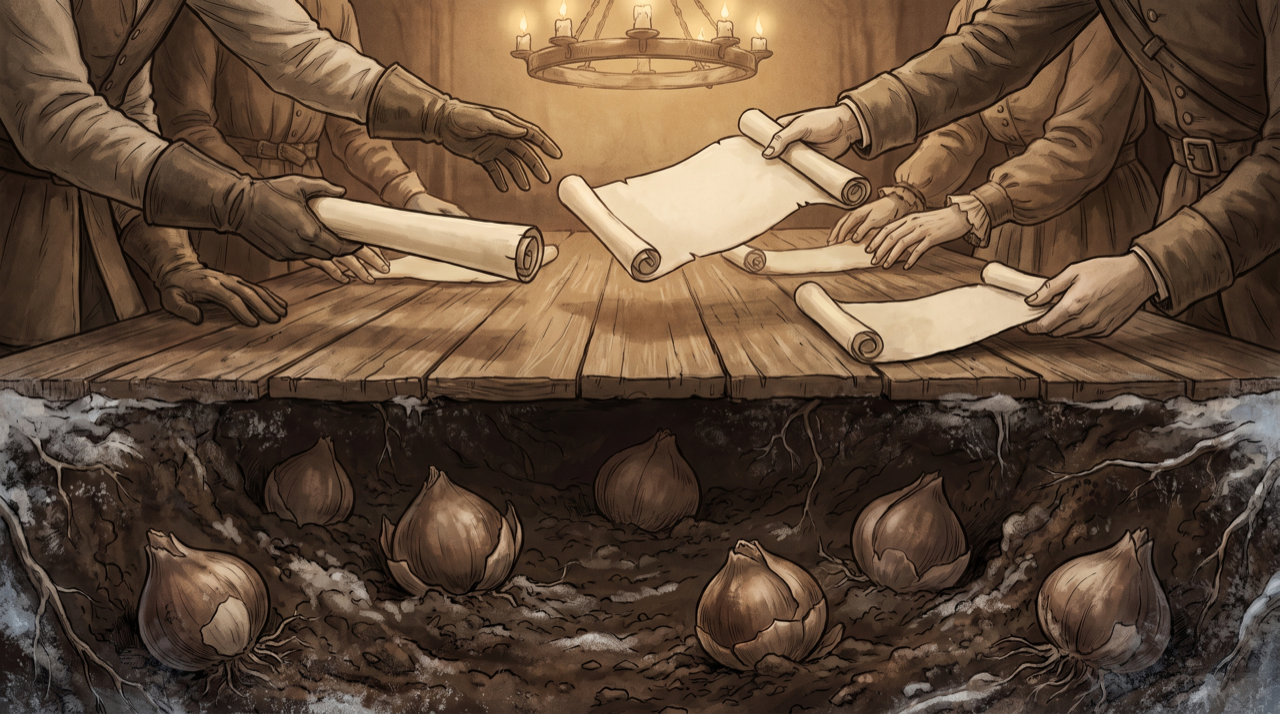
Because tulip bulbs grow underground depending on the season, it was hard to dig up and trade the physical bulb at any time. So in winter, instead of handing over an actual bulb immediately, people traded contracts promising to deliver a bulb later.
In other words, they were not buying and selling a flower in front of them, but trading a promise about a bulb to be received in the future.
Trading took place not only at an official exchange but also among people gathered in taverns and the like. A contract could be made while the buyer had not yet received the bulb and the seller had not yet handed anything over.
When prices keep rising, this structure looks very attractive.
That is because you can expect to pass the contract on to someone else at a higher price before ever taking delivery of the bulb. It became an environment in which expectations about future price, rather than the physical goods themselves, easily moved to the center of trading.
Why did the Tulip Bubble suddenly burst?
A bubble does not collapse the moment prices are simply high.
As long as the belief that someone will pay an even higher price holds, trading can continue even at expensive prices.
Conversely, the moment that belief breaks, the situation changes fast.
In early February 1637, centered on Haarlem, it became hard to find buyers in tulip trading, and the market froze abruptly. It is hard to pin down exactly which single event triggered the collapse, but it is clear that as new buyers willing to pay higher prices dwindled, the existing structure of rising prices became hard to sustain.
On top of this came the contract problem.
When prices are rising, a contract promising to buy a bulb expensively in the future looks fine. But when the market price plunges, the buyer no longer has a reason to take the bulb at the high price promised earlier.
Disputes followed over whether contracts had to be fulfilled as written or could be canceled, and local authorities had to work out solutions. In Haarlem, a scheme even emerged allowing some contract relationships to be settled by paying a certain percentage later.
In the end, rather than explaining the crash simply as “the flowers were too expensive,” it is easier to understand it as an event in which, as the expectation of continued rises vanished, the trust that had held up trading was shaken at the same time.
If you are curious which choices, from the standpoint of a market participant at the time, fueled the price rise and eventually led to the collapse, you can follow the process of the Tulip Bubble step by step as a 1630s Haarlem weaver. Connecting the stages — from taking interest in a rare bulb, to contract trading with no physical goods, to the market collapse — makes the structure of a bubble much easier to grasp.

Was a single tulip really the price of a house?
The story that comes up most often when explaining Tulip Mania is the phrase “a single tulip bulb cost as much as a house.”
It is true there were rare bulbs recorded at very high prices. In historian Anne Goldgar’s research, some of the top-level trade records reach around 5,000 guilders. There is no doubt this was a considerable sum at the time.
But it is a mistake to treat such extreme trades as the typical price of tulips in general back then.
Research today explains that the people who took part in the tulip frenzy did not represent Dutch society as a whole, and that trading was concentrated in particular human networks — especially wealthy merchants and skilled artisans.
The famous story that countless Dutch people went bankrupt because of the tulip price crash, and that the national economy fell into a serious depression, is also pointed out as hard to back with clear evidence. Goldgar’s archival research holds that while the price plunge itself did happen, its social and economic damage was more limited than the tale handed down to later generations.
So Tulip Mania needs to be understood by separating the actual events from the later legend.
Why the Tulip Bubble is still often cited today
The most interesting part of Tulip Mania is not the tulip as a product.
The key is how people judged prices.
At first, prices rise because of rarity and beauty. As the rise continues, the rise itself creates new demand. People who see others making money enter the market, and as new buyers come in, prices rise again.
Then at some point, the flow of new buyers coming in slows.
Confidence in continued price rises wavers, and the expectation of being able to sell for more disappears. The high price that once looked attractive suddenly turns into a burden.
This process is not a phenomenon that appears only in one particular era.
In asset bubbles, there often comes a moment when expectations about how much other market participants will pay in the future matter more than judgments about actual value. A price rise creates expectations of further rises, and those expectations pull prices up again — a self-reinforcing process.
Conversely, when expectations break, the same structure can work in reverse.
The key to remember from the Tulip Bubble
If you remember Tulip Mania simply as “an event where people long ago went crazy over flowers and lost a fortune,” you miss the important part.
Rare tulips did have genuine demand, and some varieties were hard to produce. So it is not as if people were blindly trading something worthless from the start.
The problem is that as the price rise continued, the standard for judging value changed.
The more people care about whether someone else will buy it for more in the future than about why they themselves want the asset, the further the price can drift from real demand.
And the moment the next buyer to sustain that expectation disappears, the mood of the market can change faster than expected.
Historical debate remains over the exact size and damage of the 1637 tulip market, but the point that collective expectations of price increases push asset prices up, and that when the belief breaks the trading structure itself can be shaken is why Tulip Mania is still cited again and again, centuries later.