
Simple vs Compound Interest: How Interest Earns Interest
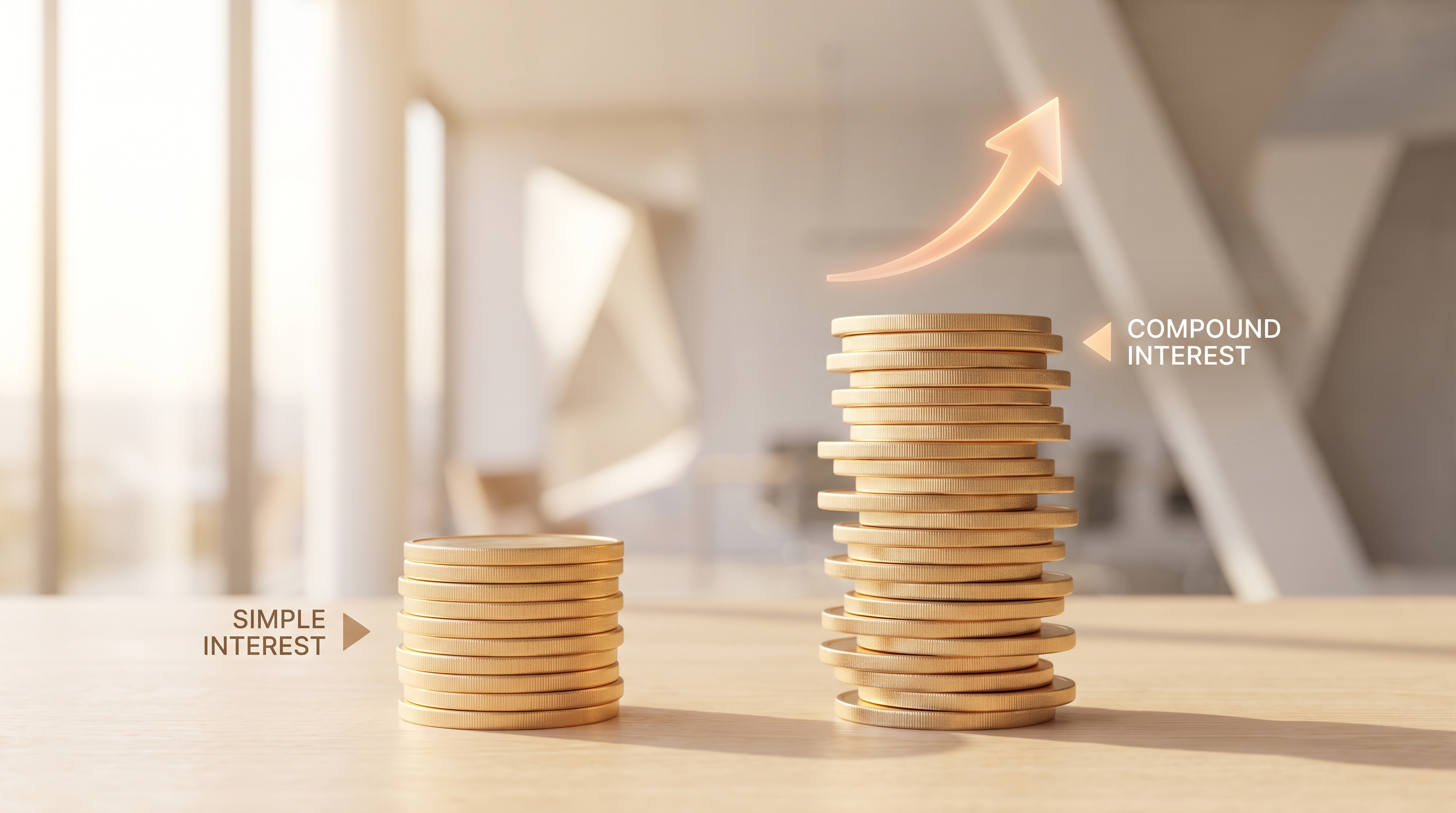
When you put money in a bank or invest it, it earns interest. But at the same rate, how that interest is calculated can make a real difference in what you end up with years later. That difference is simple versus compound interest.
Put simply, simple interest is earned only on the amount you started with, while compound interest is also earned on the interest you have already piled up. That small distinction snowballs over time.
Simple interest: only on the principal
Simple interest is calculated on the original principal alone, so the amount added each year stays the same from start to finish.
For example, $10,000 at 5% simple interest earns $500 every year. After three years that is exactly $1,500 in interest. The math is intuitive: just multiply the principal by the rate and the number of years.
Compound interest: interest that earns interest
Compound interest works a little differently. Each year's interest is added to the balance, and the next year's interest is calculated on that larger amount.
The same $10,000 at 5% compound interest grows to $10,500 after one year, and in the second year you earn 5% on $10,500, reaching about $11,025. As interest keeps earning interest, the balance grows faster and faster.
The gap widens with time
Over a short span the two look almost identical. Give it time, though, and the story changes. Here is a $10,000 balance at 5%.
| Time | Simple balance | Compound balance |
|---|---|---|
| 1 year | $10,500 | $10,500 |
| 5 years | $12,500 | about $12,763 |
| 10 years | $15,000 | about $16,289 |
| 20 years | $20,000 | about $26,533 |
The balances match after year one, but after 20 years compounding is ahead by more than $6,500. A tiny early difference turns into a large one — that is the nature of compounding.
So with compounding, time matters as much as the rate. Even a modest rate builds a real effect if you can leave it alone long enough. The flip side is that when you borrow, the same mechanics work against you, so it is worth checking whether a loan's interest compounds.
It all becomes far more tangible when you change the numbers yourself. Try entering a principal, rate, and time to see how the result shifts.