
Causes of the Great Depression: Why the 1929 Crash Became a Global Collapse

The Great Depression is often described as an economic crisis that began with the 1929 U.S. stock market crash. But the fall in share prices alone cannot fully explain the prolonged economic collapse of the 1930s.
Borrowed-money investing had already grown rapidly in the market, and a banking crisis, credit crunch, and deflation followed one after another. Combined with the gold standard and the protectionist trade policies of the time, a shock that began in the United States spread to many countries.
In short, the 1929 crash was an important trigger for the Great Depression, but not its only cause.
What was the Great Depression?
The Great Depression was a severe economic downturn that began in 1929. In the United States especially, production and consumption contracted sharply in the early 1930s, unemployment surged, and many banks and businesses shut down.
According to the U.S. Federal Reserve's historical materials, total U.S. output of goods and services fell by about 30% during the Depression, and unemployment rose to roughly 25% in 1933. The U.S. economy is described as having returned to full production and employment during World War II.
But if you understand the Depression simply as “a time when the economy was very bad,” it is easy to miss the point.
The problem is that once the economy turned down, it could not recover and fell into a vicious cycle: falling stocks → financial instability → banking crises → less lending → less spending and investment → rising unemployment → more bad debt.
Why was the stock market so overheated before the Depression?
In the 1920s, the U.S. economy had a strongly optimistic mood as new industries like automobiles and electrical goods grew. The stock market rose quickly, and stock investing gradually spread to the general public.
The problem was that people were not buying stocks with only their own money.
Buying big stocks with little money: margin buying
At the time, margin buying was widely used, in which you paid only part of a stock's price in cash and borrowed the rest.
According to the Fed's historical materials, an investor could put in part of the price, commonly about 10%, and borrow the rest. The purchased stock itself served as collateral for the loan.
For example, even with little of your own money, using debt lets you hold far larger assets.
While prices are rising, there seems to be no big problem. In fact, returns on your own equity grow greatly.
But when prices start to fall, the situation changes completely.
If the value of the pledged stock drops, the investor must put in more money, and if they cannot, their holdings may be sold off by force. When this happens to many investors at once, a structure forms in which falling prices trigger still more selling.

In this structure, a rising price itself becomes a force that draws in more investment.
Rather than asking “is the price rising because the company's value improved?”, the expectation that “it keeps rising, so it will rise more” easily grows. Conversely, the moment that expectation breaks, the move in the opposite direction can appear far faster than the rise.
How did the 1929 crash begin?
As the market's mood shifted, selling pressure grew quickly in the autumn of 1929.
On October 24 came the massive sell-off known as Black Thursday. As the decline continued, on Black Monday, October 28, the Dow Jones Industrial Average fell about 13% in a single day, and the next day, Black Tuesday, about 12%. By mid-November the index had dropped to nearly half its peak.
It was especially devastating for investors who had bought stocks with debt.
As prices fell, collateral values dropped, and the holdings of investors who could not raise more cash came back onto the market. As supply grew, prices fell further, and that decline could create still more forced selling, a vicious cycle.
If this is hard to grasp from text alone, you can follow the causes of the Great Depression by making choices in the 1929 situation and see how margin buying leads to an overheated market and finally to collapse.
But here we need to distinguish one thing.
A stock market crash does not by itself mean the entire Great Depression.
In fact, the Fed's historical materials note that the direct shock of the 1929 crash eased after a few months, and by the autumn of 1930 a recovery seemed possible. The banking crises that followed played a key role in turning a relatively short downturn into a far more severe Depression.
The key reason the crash spread into the Depression was the banking crisis
At the time, there was no deposit-protection system of the kind we have today.
When rumors spread that a bank was in danger, depositors rushed to withdraw their money first. This is called a bank run.
Banks do not keep all deposited money in cash. Some is lent to businesses and households or invested in other assets.
So even a bank that normally operates soundly can face serious trouble if many customers try to withdraw at once.
From 1930, this kind of banking instability repeated in several regions, and after 1931 the financial crisis spread far more widely.
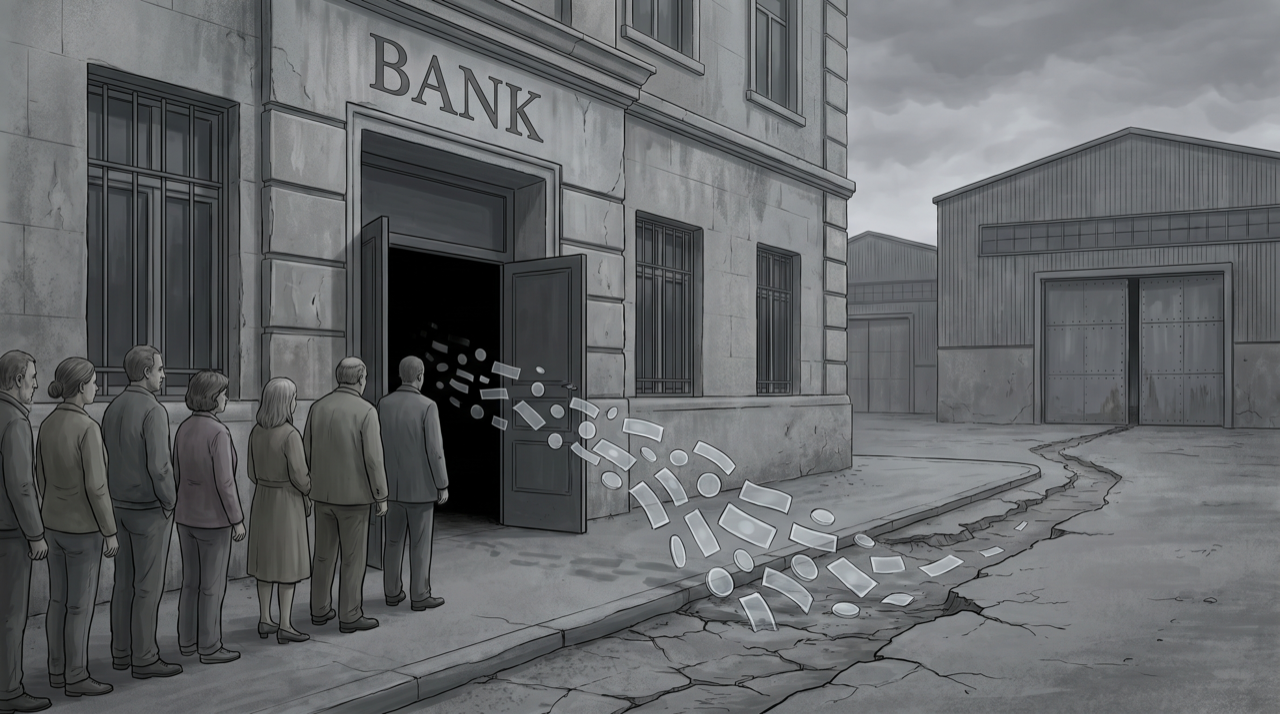
When a bank fails, the damage does not end with its shareholders or depositors.
When banks cut lending, businesses struggle to find operating or investment funds. When businesses cut production, employment falls, and as the jobless grow, household spending shrinks.
When spending falls, business revenue drops again.
In this way, a financial problem is transmitted to the entire real economy.
Deflation made the Depression deeper
To understand the Depression, you also have to look at deflation.
Deflation is a sustained fall in the general level of prices.
When prices fall it may seem good for consumers, but the story is different when the whole economy carries a lot of debt.
Suppose the nominal amount of debt stays the same while prices and wages keep falling.
Business revenue and personal income fall, but the amount of debt to repay stays the same. As a result, the real debt burden grows heavier.
During the Depression, banking crises and increased cash holding led to a shrinking money supply. According to the Fed's historical materials, from the autumn of 1930 to the winter of 1933 the U.S. money supply fell by nearly 30%, and the deflation in this process further deepened falling consumption, bankruptcies, and rising unemployment.
In other words, a vicious cycle formed: banking instability → less lending → shrinking money supply → falling prices → heavier debt burden → less spending and investment → business failures → banking instability.
Why was the Federal Reserve's response not enough?
One point often raised in analyzing the Depression today is the response of the U.S. Federal Reserve at the time.
Although banking crises repeated from 1930, the Fed is judged not to have supplied enough liquidity to the financial system at the level expected of a central bank today.
Policymakers of the time had almost no experience managing a financial crisis on the scale of the Depression, and even within the Fed there were differences of view over how to respond.
There was also the constraint of the gold standard.
Under the gold standard, the value of currency was linked to gold, so it was difficult for the central bank to freely expand the money supply in response to a financial crisis.
As international financial instability grew in 1931, pressure to prevent gold outflows also affected monetary policy. The Fed's historical materials explain that policies to defend the gold standard and the insufficient response to banking crises contributed to deepening the deflation.
Why did America's Depression spread to the world?
The major economies of the 1930s were not completely independent of one another.
Because many countries were linked by the gold standard in particular, one country's monetary and financial instability could affect others.
If gold flowed out of a country, pressure could arise to raise interest rates or contract credit to stop the outflow. When such policies are carried out during a downturn, the economy can contract even further.
So the financial shock and deflation that began in the United States were transmitted to other industrial nations through the international financial system.

The trade environment also worsened.
The United States enacted the Smoot-Hawley Tariff Act in 1930, applying high tariffs to many imports, and protectionist measures expanded in many countries as well.
However, there is scholarly debate over just how much the Smoot-Hawley tariff deepened the Depression. The U.S. State Department's historical materials, too, rather than concluding that a single tariff law caused the entire collapse of world trade, explain that the competitive protectionist policies adopted by many countries contributed to a sharp contraction in international trade.
So rather than seeing protectionism as the single cause of the Depression, it is more appropriate to understand it as one of the factors that worsened an already-underway global downturn.
How did recovery begin after 1933?
When the U.S. financial crisis reached its peak in 1933, the administration of Franklin D. Roosevelt declared a nationwide bank holiday.
Rather than reopening banks unconditionally, it let banks judged sound after a review of their finances resume business first, and reforms of the financial system including the Emergency Banking Act were carried out. Deposit insurance through the Federal Deposit Insurance Corporation (FDIC) was later introduced.
The link to the gold standard was also weakened, and policies to stop falling prices were implemented.
After 1933 the U.S. economy entered a recovery phase, but the recovery did not proceed smoothly. In 1937–1938 a severe downturn occurred again.
The Fed explains that a full return to pre-Depression production and employment was achieved during the large-scale production expansion of World War II.
Why the cause of the Depression is hard to explain with a single factor
As you study the Depression, you come to ask, “what ultimately caused it?”
But it is hard to explain by picking just one thing.
The 1929 crash was a big shock, but it did not by itself automatically produce a years-long Depression.
Many factors were linked together.
Stock-market overheating and margin buying raised the vulnerability of financial markets, and the crash worsened consumer and investment sentiment. Banking crises then broke the supply of credit, and a shrinking money supply and deflation raised the debt burden further.
The gold standard acted as a constraint that made it hard for many countries to respond actively during a downturn, and international financial instability and expanding protectionism became factors that transmitted or worsened the shock across countries.
In the end, the Depression was less a single event than a crisis of the entire economic system, arising as many vulnerabilities operated in a chain.
What we can still learn from the Depression
This is also why the Depression is still studied in economic history.
First, what matters is not the asset-price crash itself but how well the financial system can withstand that shock. Even if stocks fall, if banks and the credit system keep working normally, the extent to which the shock spreads to the whole real economy can be reduced.
Second, deflation is not simply things getting cheaper. In an economy with heavy debt, the more incomes and asset prices fall, the heavier the real debt burden becomes, which can deepen a downturn.
Third, it shows why a central bank's liquidity provision and depositors' trust matter in a financial crisis. The experience of that time lies behind the major development of deposit insurance, financial supervision, and central-bank crisis response after the Depression.
Finally, the Depression shows that an economic crisis is not just a matter of numbers. When losses in financial markets pass through banks and businesses into employment and household income, ordinary people's lives are directly affected.
So the heart of the Depression lies less in the fact that stocks crashed in 1929 than in the fact that a financial and monetary system that could not absorb the shock created a vicious cycle.
Looking together at stock-market overheating, debt-fueled investing, banking crises, deflation, and the linkage of the gold standard and the international economy, you can understand far more clearly why the Depression grew beyond a simple market crash into one of the most severe economic crises in history.