
The 2008 Financial Crisis Explained: How Subprime Mortgages Brought Down Lehman Brothers and the Global Economy

The 2008 financial crisis was not simply a story of American home prices falling. It was closer to a slow build-up of risk inside a deeply interconnected financial system — mortgage lenders, investment banks, securitized products, rating agencies, insurance companies, and the short-term funding markets — that all came undone at once.
The failure of subprime mortgages was the starting point, but what turned a housing problem into a global financial crisis was the combination of complex products like MBS and CDOs, high leverage, risk transfer through CDS contracts, heavy reliance on short-term funding, and the dense web of connections between financial institutions.
The US recession officially ran from December 2007 to June 2009 — a period widely known as the Great Recession. Financial-market stress appeared earlier than that, and it turned extreme around the bankruptcy of Lehman Brothers in September 2008.
What exactly was the 2008 financial crisis?
To understand 2008, it helps to separate two ideas: a financial crisis and a recession.
A financial crisis is a breakdown in the machinery of borrowing and lending — banks, investment banks, insurers, and money markets stop performing their normal function of moving money to where it is needed. A recession, by contrast, is a contraction in the real economy: spending, investment, production, and employment all shrink.
In 2008, the two became linked.
As home loans went bad, financial institutions took losses. Institutions stopped trusting each other and stopped lending to each other. As the supply of credit dried up, businesses and households found it hard to borrow, and consumption, investment, and hiring all fell.
In short, the shock traveled along a chain: housing-market trouble, then a financial-market crisis, then a credit crunch, then a real-economy recession.
It started with a housing boom
The crisis did not appear out of nowhere in 2008. The risk had been accumulating for years.
From the late 1990s through the mid-2000s, the US housing market boomed. Average home prices more than doubled between 1998 and 2006, and mortgage lending grew rapidly alongside them.
Several forces were pulling money into housing at the same time: low interest rates and abundant global capital, a widespread belief that home prices would keep rising, fierce competition among lenders, and the growth of the securitization market, where mortgages could be repackaged into financial products and sold to investors.
That last piece brought a crucial change in incentives.
In the traditional model, when a bank made a mortgage loan, it had to care — for decades — whether the borrower kept paying it back.
But as the market for selling loans to other investors grew, the structure changed. A bank could now originate a loan, package it into a financial product, and pass it along to someone else.
What went wrong with subprime mortgages?
A subprime mortgage is a home loan made to a borrower whose credit history makes it hard to qualify for a loan on standard terms.
Lower credit does not automatically mean a bad loan. The real problem was that as the housing boom rolled on, lending standards steadily eroded.
Loans were made with little or no verification of income or assets. Adjustable-rate mortgages spread that offered low "teaser" payments at first, then reset to much higher rates after a few years.
As long as home prices kept climbing, none of this looked like a problem.
Even if a borrower couldn't afford the payments, they could sell the house at a higher price, or refinance using the equity that rising prices had created.
But the entire structure rested on one assumption: home prices had to keep going up.
The moment prices stopped rising, the story changed completely.
How MBS spread the risk into financial markets

You cannot understand 2008 without understanding mortgage-backed securities.
An MBS (mortgage-backed security) is a security built on the principal and interest payments flowing from a pool of home loans.
Here is a simple version. Suppose a bank has made mortgage loans to thousands of borrowers. Normally, the bank would have to wait years, collecting payments until each loan matured.
Instead, it can bundle those loans together into a financial product and sell it to investors. The bank gets its money back quickly and can turn around and make new loans.
That is the basic logic of securitization.
Securitization is not inherently bad. It spreads loan risk across many investors and channels more funding into the economy.
The problem was that as the originate-to-sell model expanded, the company making the original loan had less reason to care about its long-term quality. If a loan could be packaged and sold no matter how it was underwritten, growing loan volume could become more profitable than maintaining loan quality.
When subprime defaults began climbing in 2007, the value of the securities built on those mortgages began to crack.
CDOs made the structure even more complex
The next step beyond MBS was the CDO.
A CDO (collateralized debt obligation) is a structured product created by re-bundling various bonds and loan-related securities into a new package.
Its defining feature was the tranche structure: one pool of assets sliced into layers by risk. When losses occur, the riskiest layers absorb them first, while the senior layers are designed to be hit last.
Using this design, a product could contain genuinely risky assets and still have portions of it carry the highest credit ratings.
The flaw was that the models did not adequately account for a scenario in which the underlying mortgages went bad at the same time. Mixing home loans from different regions was supposed to diversify the risk — but when home prices started falling across the entire country at once, the diversification turned out to be far weaker than assumed.
Credit rating agencies played a central role in assessing these structured products, and post-crisis investigations pointed to the rating system — and its conflicts of interest — as one of the crisis's key contributing causes.
If it's hard to picture how MBS, CDOs, and CDS all connect just from reading, you can follow how a home loan turns into a financial product and how risk spreads through the whole system in an interactive story.
How did CDS contracts put even AIG at risk?
A CDS (credit default swap) is a derivative designed to compensate the buyer if a credit event — such as a default — hits a particular bond or financial product. Think of it as a contract for protecting against credit risk.
Like securitization, CDS contracts were not the cause of the crisis by themselves.
The problem was that the volume of CDS trading tied to housing-related securities ballooned, and the web of exposures between interconnected financial firms became impossibly tangled.
The textbook example is the insurance giant AIG.
AIG had written enormous credit-derivative contracts with financial institutions around the world. As housing-related securities lost value and AIG's own credit rating was cut, collateral calls and liquidity pressure piled up fast.
On September 16, 2008 — the day after Lehman Brothers filed for bankruptcy — the Federal Reserve concluded that a disorderly AIG failure could deliver a severe shock to the entire financial system, and authorized a credit line of up to $85 billion.
This episode reveals one of the defining features of 2008: transferring risk to someone else did not remove it from the financial system.
The risk had merely moved to a different institution.
Leverage made the losses bigger
Another key amplifier of the crisis was leverage — operating with far more assets than capital by relying on borrowed money.
If you invest mostly with borrowed funds, rising asset prices deliver outsized returns on your own capital.
But the reverse is just as true. Even a small decline in asset prices can wipe out equity at a frightening pace.
And when conditions deteriorate — when lenders demand more collateral or start pulling their money — an institution has to sell assets in a hurry.
When many institutions sell at the same time, market prices fall further.
Falling prices lead to bigger losses, which trigger more collateral calls, which force more asset sales, which push prices down again — a self-reinforcing spiral.
When this deleveraging happens across the whole financial system at once, even perfectly sound assets can crash.
Why did one bank's problem infect the entire market?
In 2008, many financial institutions depended heavily on money borrowed in short-term funding markets rather than on stable, long-term financing.
In normal times that looks fine. When today's loan comes due, you simply borrow again tomorrow.
But everything changes once market participants start doubting whether their counterparties are safe.
"I have no idea how much toxic paper that firm is holding."
"What if I lend to them today and they're bankrupt tomorrow?"
As that anxiety spread, institutions grew reluctant to lend to one another at all.
One of a financial institution's most important assets is, ultimately, trust — and in 2008, trust is exactly what collapsed.
Falling home prices set off the vicious cycle
The US housing boom began losing steam in the mid-2000s.
Once prices started falling, homeowners could no longer sell or refinance their way out of trouble, and delinquencies and foreclosures climbed.
Losses then mounted in the MBS and CDOs built on those mortgages.
Worse, it became genuinely unclear how the complex products on banks' balance sheets should even be valued. As trading dried up, some assets had no observable market price at all.
With no way to know which firm was hiding how much in losses, distrust deepened further.
The warning signs were already flashing in 2007
We call it the 2008 financial crisis, but the serious cracks appeared in 2007.
New Century Financial, one of the largest subprime lenders, filed for bankruptcy in April 2007, and a wave of downgrades hit mortgage-related securities in the months that followed.
Financial institutions could no longer tell how much loss was buried inside housing-related products, and the short-term funding markets began to wobble.
By December 2007, the US economy had entered recession.
But the decisive blows to the financial system came in 2008.
The key events of 2008, in order

March 2008: The Bear Stearns crisis
Bear Stearns, one of the major US investment banks, fell into a severe liquidity crisis.
It was ultimately acquired by JPMorgan Chase in a deal arranged with support from the Federal Reserve.
Markets were already deeply uneasy, but the episode reinforced a certain expectation among market participants: if a major financial institution got into serious trouble, it would somehow be rescued.
September 2008: Everything unravels
In September 2008, a series of shocks landed within days of each other.
Fannie Mae and Freddie Mac — the giant government-sponsored mortgage companies, badly wounded by housing losses — were placed into government conservatorship.
Then the crisis at the investment bank Lehman Brothers accelerated dramatically.
September 15, 2008: Lehman Brothers goes bankrupt
Lehman Brothers filed for bankruptcy protection — the event that came to symbolize the entire crisis.
But Lehman's collapse did not create the crisis.
Serious problems already existed in the housing market and the financial system. It is more accurate to say that Lehman's failure explosively amplified a crisis that was already underway.
September 16, 2008: The AIG rescue
The very next day, AIG fell into a critical liquidity crisis.
Because an AIG failure threatened to destabilize contracts with countless financial firms around the world simultaneously, the Federal Reserve authorized up to $85 billion in credit support.
Even money market funds began to break
Around the same time, the Reserve Primary Fund — a US money market fund holding Lehman debt — took losses that pushed its share price below $1, the infamous "breaking the buck."
Most investors had treated money market funds as essentially equivalent to cash.
When that belief shattered, investors rushed for the exits. According to the Securities and Exchange Commission, roughly $300 billion flowed out of prime money market funds during the week of September 15, 2008.
The crisis was no longer confined to mortgages and investment banks — it had reached the short-term funding markets that ordinary businesses rely on every day.
Why the Lehman bankruptcy was so shocking
When Lehman failed, the world economy did not simply lose one big bank.
Financial institutions are bound together by countless contracts — loans, bonds, derivatives, collateral arrangements, repurchase agreements. The web is so tangled that when one firm fails, nobody can immediately tell how much anyone else stands to lose.
After Lehman, that uncertainty became extreme.
Unsure whether their counterparties would even exist tomorrow, institutions scrambled to hoard cash. Instead of lending, they stockpiled; anything that looked risky, they sold.
The financial system's core function — moving money from those who have it to those who need it — began to seize up.
This is what economists call a credit crunch.
How the crisis spread to the real economy
When banks stop lending, the pain does not stay on Wall Street.
Companies can't raise money to build factories or buy equipment. When working-capital loans dry up, even healthy businesses can struggle to make payroll or stock inventory.
Households find it harder to get mortgages, auto loans, and consumer credit. At the same time, falling home and stock prices shrink household wealth.
People cut spending; companies cut investment. As revenues fall, companies cut jobs. Falling household income cuts spending further.
It is the classic path by which a financial crisis becomes a recession.
How hard was the US economy hit?
According to the Federal Reserve's historical records, US real GDP fell about 4.3% from its peak in the fourth quarter of 2007 to its trough in the second quarter of 2009.
The unemployment rate climbed from 5% in December 2007 to 10% by October 2009.
Home prices fell roughly 30% on average from their mid-2006 peak to mid-2009, and the S&P 500 dropped about 57% from its October 2007 high to its March 2009 low.
The crisis was never just a story of Wall Street losses. It reached housing, jobs, spending, and business activity across the entire economy.
How did the government and the Fed respond?
As the risk of a full financial-system collapse grew, the US government and the Federal Reserve took action on an unprecedented scale.
Cutting interest rates
The Fed cut its federal funds rate target repeatedly, from 5.25% in September 2007 all the way down to a range of 0 to 0.25% by December 2008.
Pumping liquidity directly into markets
Rate cuts alone could not restart frozen funding markets, so the Fed created a series of new emergency lending facilities.
Funding flowed not just to banks but to investment banks, the commercial paper market, the asset-backed securities market, and beyond.
TARP
In October 2008, Congress passed the Emergency Economic Stabilization Act, creating the Troubled Asset Relief Program (TARP).
Here lies a common misunderstanding. TARP was originally authorized for up to $700 billion — but that does not mean the government spent, let alone lost, $700 billion.
According to the Treasury Department, the amount actually deployed was well below the authorization, and after accounting for repayments and recovered investments, TARP's ultimate cost was far lower still.
Quantitative easing
The Fed then began large-scale purchases of Treasury bonds and mortgage-backed securities.
With its policy rate already near zero, this was a way to push down long-term interest rates and ease financial conditions when conventional rate cuts had run out of room.
Why did the crisis spread around the world so fast?
Because global financial markets were already tightly woven together.
The MBS and CDOs created by US institutions were not held only by American investors. Banks, insurers, and investment firms across many countries held them too.
On top of that, international financial institutions were lending to each other and trading derivatives with each other. A loss anywhere in the network inevitably meant losses elsewhere.
The other problem was uncertainty itself — not knowing who was holding how much risk.
In a financial crisis, the inability to measure losses can be as dangerous as the losses themselves. If nobody can tell whether Bank A is solvent, nobody will lend to Bank A.
And when every institution makes that same defensive choice at once, even perfectly healthy firms can find themselves unable to raise funds — and get dragged into the crisis anyway.
The whole crisis, connected in one chain
Put all the pieces together and the story runs like this:
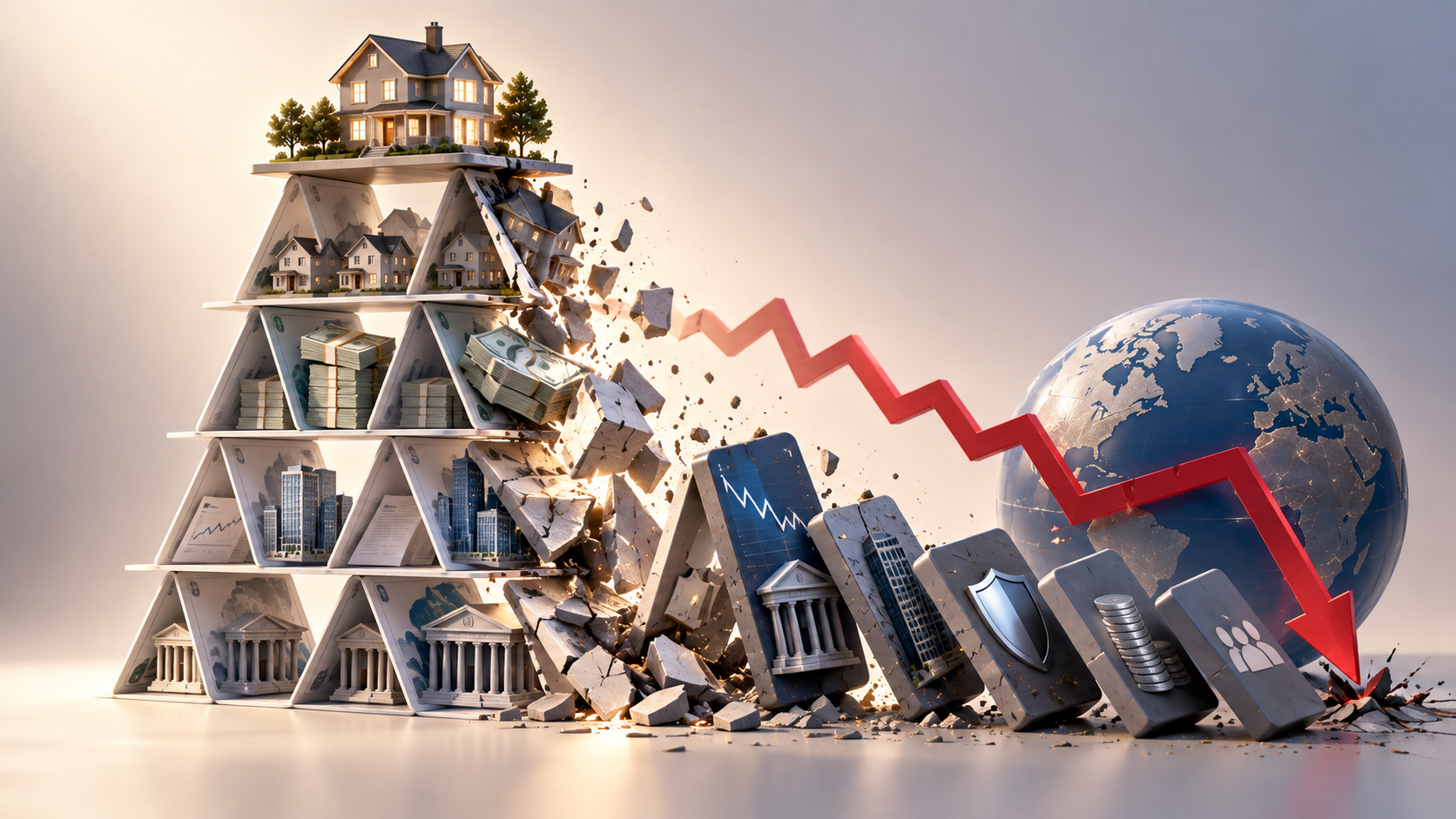
Expectations of ever-rising home prices grow → mortgage lending expands → lending extends to weaker and weaker borrowers → loans are bundled and sold as MBS → those products are re-bundled into CDOs and other structured products → sold to investors worldwide on the strength of credit ratings and financial engineering → credit-risk trading expands through CDS → leverage and interconnection across financial institutions grow → US home prices fall → delinquencies and foreclosures rise → MBS and CDO values fall → financial institutions rack up losses → firms stop trusting each other → short-term funding markets freeze → Lehman Brothers fails → panic spreads through markets → lending to businesses and households contracts → spending, investment, and jobs decline → a global recession.
Follow this chain and one thing becomes clear: 2008 was never just a "housing crash."
Misconception 1: Subprime loans alone caused the crisis
Subprime defaults were the crucial starting point, but by themselves they cannot explain the sheer scale of a global financial crisis.
Ben Bernanke, the Fed chair at the time, later argued that the direct subprime losses did far less damage to the economy than what followed: spreading instability across markets and institutions that choked off the supply of credit.
Subprime lit the match. High leverage, fragile funding structures, complex securitization, failed risk management, and dense interconnections between institutions were what turned it into a fire.
Misconception 2: The crisis started when Lehman went bankrupt
Lehman's failure was not the beginning.
The housing market was already falling, subprime lenders and mortgage securities had been in trouble since 2007, and Bear Stearns had effectively collapsed back in March 2008.
Lehman's bankruptcy was the event that pushed an ongoing crisis into a far more severe phase.
So rather than "Lehman's failure caused the crisis," the accurate version is: a crisis already in motion escalated into an extreme collapse of trust after Lehman fell.
Misconception 3: MBS, CDOs, and CDS are inherently bad products
This, too, is an oversimplification.
MBS channel funding into home lending through securitization, and CDS can be legitimate tools for managing or transferring credit risk.
The real questions were about how they were used: What assets were they built on? Was the risk honestly measured? Who held how much? Could counterparties actually deliver on their promises? Were institutions running on far too much borrowed money?
Even sound financial products can destabilize an entire system when combined with distorted incentives, excessive leverage, and opaque risk management.
The biggest lessons of 2008

One of the central lessons of the crisis is this: moving risk is not the same as eliminating it.
When a bank packages loans into MBS and sells them, the risk may leave the bank's books. A CDS can shift a particular investor's credit risk somewhere else.
But the institution that takes on that risk is still part of the financial system. When firms are tightly interconnected, risk that each institution believes it has diversified away can still be sitting there, intact, at the level of the system.
The second lesson: leverage is far more dangerous on the way down than on the way up. Rising prices magnify gains quickly — and falling prices magnify losses just as quickly.
The third: never assume liquidity will always be there. Short-term funding that seems endlessly rollable in calm times can vanish in an instant when fear takes hold.
Finally: in a financial system, you have to watch the connections, not just the individual institutions.
Each firm's behavior can look perfectly rational in isolation, yet become dangerous when everyone does it at once. When markets turn shaky, selling assets and hoarding cash is a sensible move for any single institution. But when every institution sells at the same time, prices collapse and the system's total losses grow far larger.
What changed after the crisis?
In the years that followed, the US and many other countries tightened the rules: stronger bank capital and liquidity requirements, closer supervision of the largest institutions, reforms to derivatives trading, and new consumer financial protections.
In the US, the Dodd-Frank Act of 2010 launched a sweeping overhaul of financial regulation aimed at the weaknesses the crisis had exposed.
Internationally, banks were required to hold more loss-absorbing capital and to prepare for short-term liquidity shocks.
None of this guarantees there will never be another financial crisis. Crises change shape from era to era.
But 2008 demonstrated, unmistakably, how fragile a financial system becomes when high leverage, opaque risk, short-term funding dependence, and excessive interconnection all show up at the same time.
The key things to remember about 2008
The 2008 financial crisis cannot be pinned on any one bank or any one financial product.
Optimism about ever-rising home prices, eroding lending standards, the growth of subprime mortgages, securitization through MBS and CDOs, failures in credit ratings, tangled risk connections through CDS, high leverage, and dependence on short-term funding had all been layering on top of each other for years.
When home prices fell, every weakness in that structure was exposed at once. And after Lehman Brothers collapsed, trust between financial institutions broke down — turning a housing-market problem into a global financial crisis and a worldwide recession.
That is why the most important question about 2008 is not simply "who was to blame?" but "how was the risk created, how did it move between institutions, and how did it spread through the entire system?"
Once you see that chain of connections, the individual terms — subprime mortgages, MBS, CDOs, CDS, Lehman Brothers — stop being jargon and become chapters of a single story.