
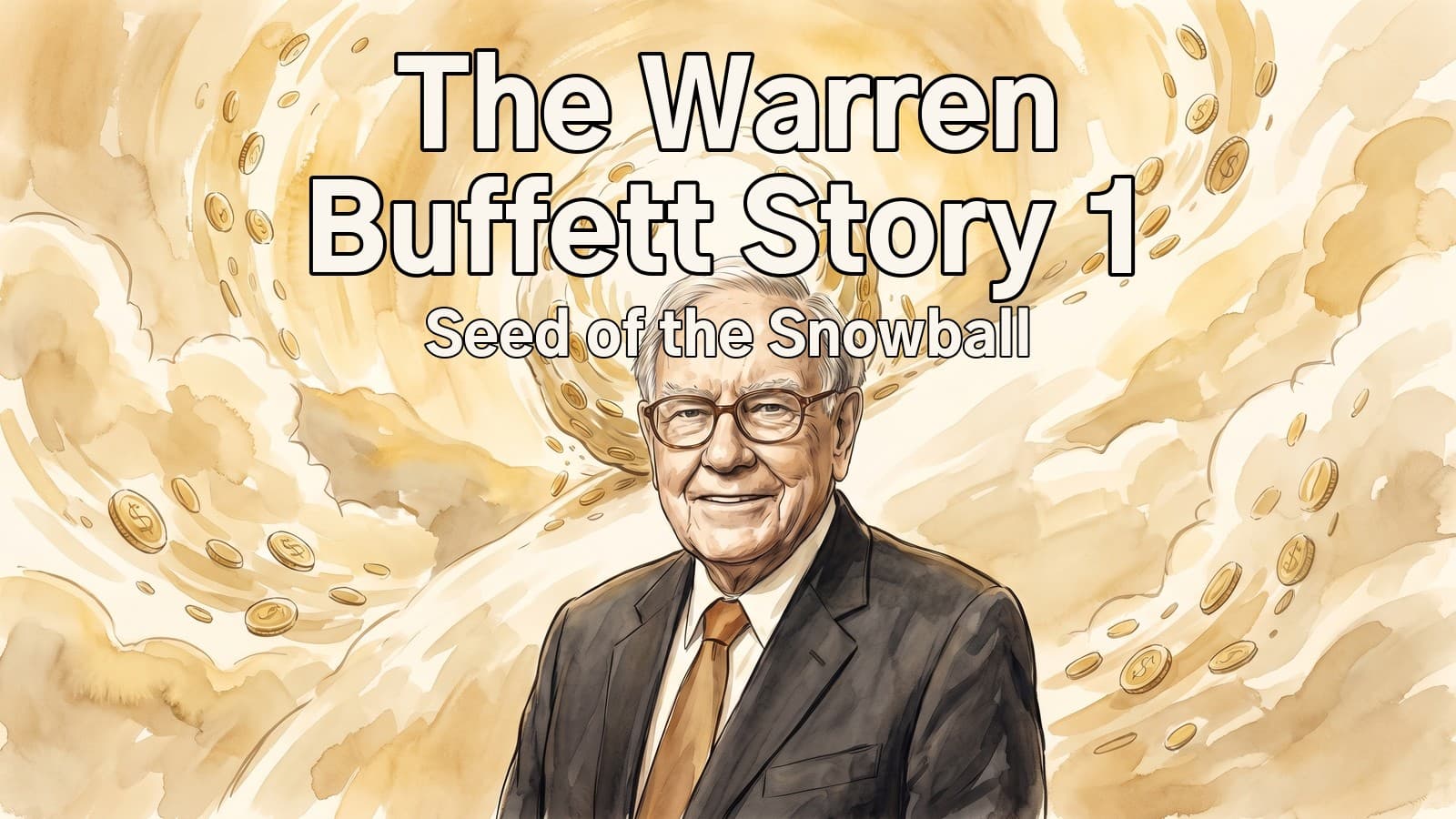
The Warren Buffett Story 1 - Seed of the Snowball
How did Warren Buffett become the world's greatest investor? Born in Omaha during the Great Depression, he discovers compounding (the snowball) in a library book, saves his first seed money by reselling Coke bottle by bottle, and sells his very first stock — bought at eleven — far too soon. A choose-your-path story following young Warren's childhood in the third person, based on real facts (Episode 1 of the biography series).
How did Warren Buffett become the world's greatest investor?
'The Warren Buffett Story' is a biography series that follows the real life of Warren Buffett as a choose-your-path story. Episode 1, 'Seed of the Snowball,' covers his childhood — from his birth in 1930 to age eleven, when he first dreamed of becoming a millionaire.
You watch young Warren from beside him, predicting 'what will he do next?', and take direct part in the moments he resells Coke and buys his first stock. Every event, year, and number follows the real record; only the characters' dialogue is naturally dramatized.
The boy who discovered the snowball (compounding)
Warren was born in Omaha in 1930, in the depths of the Great Depression. His father lost his job when the bank failed but started his own brokerage, and Warren grew up surrounded by talk of stocks.
In a library book he meets compounding: money makes money, and that money makes still more — even small money, rolled long enough, swells like a snowball. Seized by the idea, he vows to be a millionaire by thirty. To roll a snowball you need a first handful, so he buys six-packs of Coke for 25¢ and resells each bottle for 5¢ to save his seed money.
At eleven he buys Cities Service stock, his sister's share included. He holds through a fall from $38 to $27 and sells at $40 — then it soars past $200. That lesson of selling too soon stays with him for life.
What the story teaches
Three lessons Warren carved into his bones. One: don't be chained to the price you paid — what rises and falls is the market's mood, not the company. Two: if you hold something good, don't rush for the small profit in front of you; a snowball only grows if you roll it a long way. Three: take someone's money, and you take responsibility for their sleep too.
Events, years, numbers, and people are real; the dialogue is naturally dramatized to aid understanding. It is not affiliated with any company or organization.