
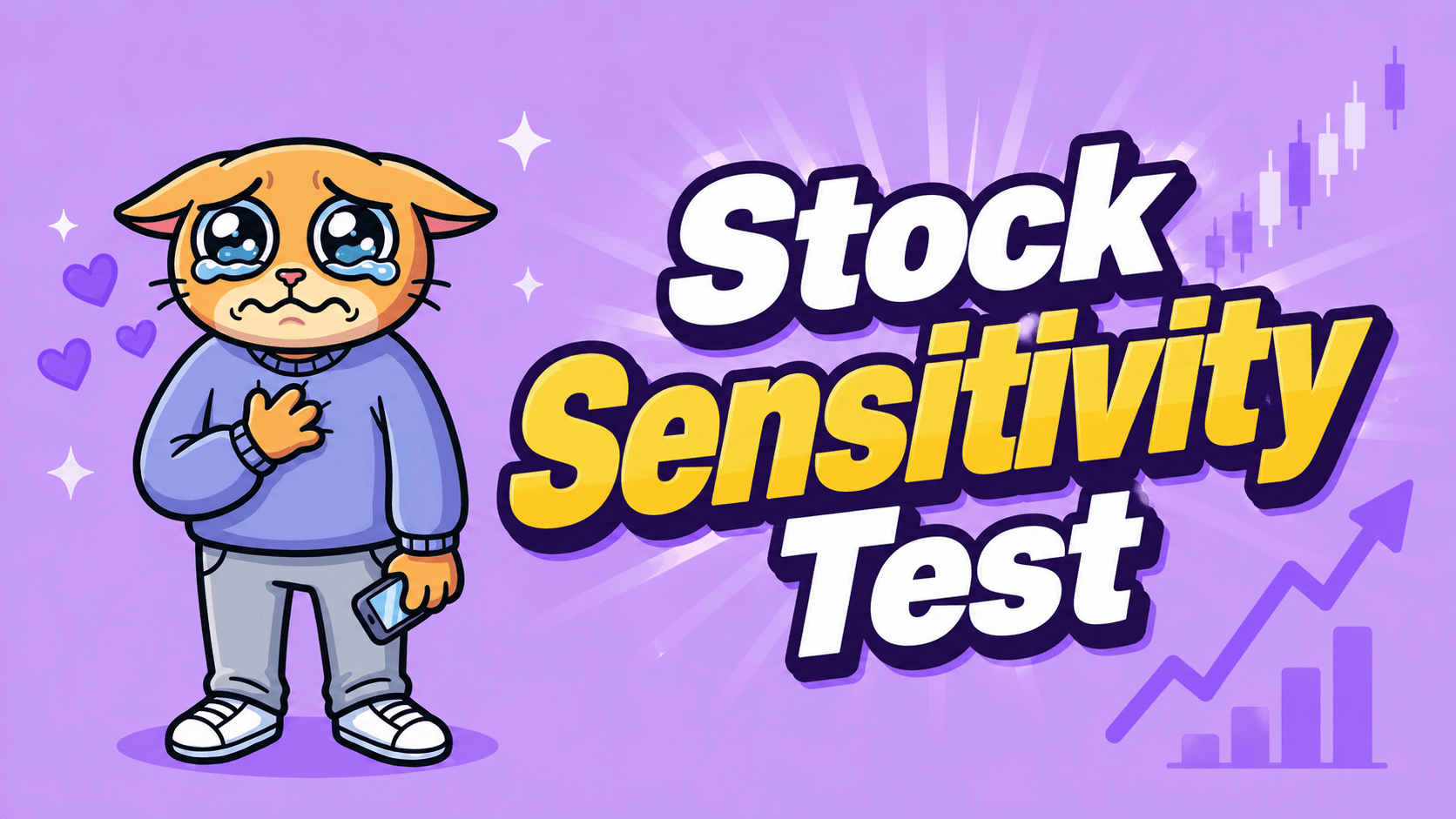
Stock Sensitivity Test
Do you sleep on the night a holding drops? Does a friend's win unsettle you? Sensitivity measures how much you feel, not how bold you are — a different axis from the Boldness Test, since you can be reckless and emotional, or cautious and unmoved. Twelve situations put your emotional swing on a 0–100 scale, and each result explains how that temperament plays out in the market.
Sensitivity — how much the market moves you
The Stock Sensitivity Test puts a number, 0 to 100, on how much your feelings move with the market. Some people sleep fine the night a holding drops. Others open the app again and again. A friend's win stings for some and registers for no one else.
This is a different axis from boldness. You can be reckless and emotional, or cautious and unmoved. A low boldness score does not mean a high sensitivity score — you need both readings to see your shape.
What the twelve questions ask
These questions are about feeling, not numbers. Can you sleep the night it drops hard? How many days does it stay with you when a stock you cut then soars? Do you blame yourself when it dips right after you buy?
It also asks whether the mood in forums changes your mind, whether your pulse rises when you open your account, and whether selling a long-held position feels like a small loss of something.
There are no right answers. The more honestly you pick, the closer the result lands to you.
Five animals, five different traps
Results come as five animals: a hamster crying literal waterfalls, a cat with a paw on its chest, a panda wobbling but catching itself, a sloth holding a coffee, and a crocodile with arms folded and no expression at all.
The sensitive end hears that when emotion presses the button, you buy high and sell low. The steady end hears that without fear, risk looks smaller than it is. Neither end is the safe one — they simply fall into different holes.
Feeling deeply is not a flaw. Hand the decision to a rule you wrote in advance, and that sensitivity turns from a cost into an edge.